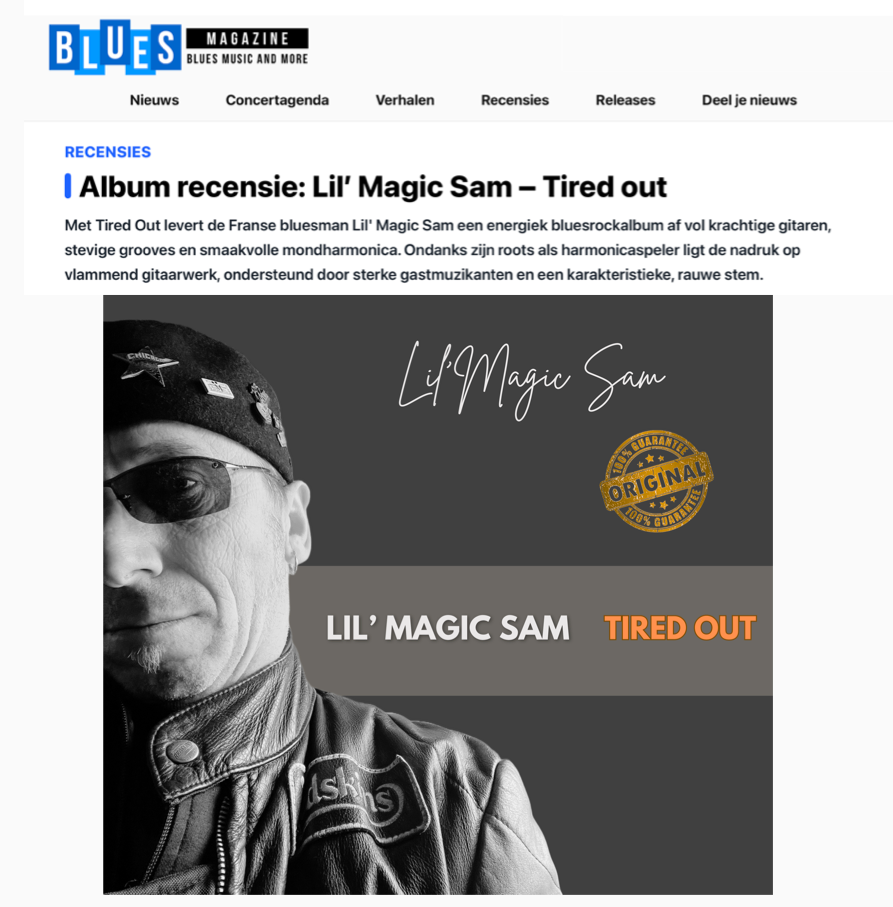


With *Tired Out*, French bluesman Lil’ Magic Sam delivers an energetic blues-rock album rich in powerful guitar work, solid grooves, and tasteful harmonica playing. Although he is primarily a harmonica player, the focus here is on spirited guitar work, backed by talented guest musicians and a raw, strong-charactered vocal style.
Lil’ Magic Sam: Better late than never
Needless to say, surprising things sometimes happen on the Internet. This week, for instance, I received an unexpected email from French blues guitarist Lil’ Magic Sam. After corresponding with him, it turned out he had already tried to contact BluesMagazine several times. For some obscure reason, however, those messages never arrived, ended up in the spam folder, or simply went unnoticed amidst the hundreds of emails BluesMagazine receives each week. So be it. Fortunately, that doesn’t stop us from reviewing this album, because for the true blues-rock enthusiast, it is a particularly delightful record.
First, a few words about Lil’ Magic Sam himself. He received a harmonica as a gift at the age of six, and it soon became apparent that he possessed exceptional talent for the instrument. At a very young age, he performed at venues such as the Casino de Paris and Bercy. In 1989, when he was just seventeen, he shared the stage with none other than B.B. King at the famous Montreux Jazz Festival. He then headed to Chicago, where he played alongside legends such as John Lee Hooker, Willie Dixon, Buddy Guy, Junior Wells, and James Cotton. However, the musician who inspired him most was Luther Allison—which is hardly surprising, given the near-legendary status Allison enjoyed in France.
*Tired Out* features thirteen original songs in a style Lil’ Magic Sam describes as follows: “raw, energetic Chicago electric blues infused with 1970s R&B, rock, soul, funk, and reggae”—a description that immediately sparks curiosity.
The opening track, "Leaving Town," sets a vigorous tone. It is a driving, hard-hitting song, propelled by a powerful Hammond organ sound and fiery guitar solos. Lil’ Magic Sam handles all the vocals and guitar parts himself, but on this track, he hands the solo over to French guitarist Vivien Verdier, who reappears later in the album.
"I’m Coming Back" then takes a different approach. Driven by a catchy piano riff, the track primarily showcases Lil’ Magic Sam’s impressive harmonica mastery. In terms of groove, "Looking So Fine" leans closer to the energetic opening track, featuring another standout contribution from Vivien Verdier.
With "Action Lady," the album takes a completely different direction. This hard-hitting track—featuring a heavy metal sound and a searing guitar solo—is the work of the second guest guitarist, Vincent Martinez.
The album title, *Tired Out*, certainly does not seem to apply to Lil’ Magic Sam. Far from appearing weary, he drives the album with a healthy dose of energetic blues-rock and fiery guitar work. His deep, raspy voice is a perfect fit for the material, while his French accent lends the sound a unique and distinctive character. Although Lil’ Magic Sam is primarily a harmonica player, this album places a clear emphasis on the guitar. The harmonica serves mainly as accompaniment, while the keyboard parts are tastefully executed by Laurian Daire. Highlights include the funk track "Before It Gets Too Late," the magnificent slow blues "All Alone"—featuring a superb interplay between harmonica, piano, and guitar—and "How Long Will It Last," a track with a guitar sound strongly reminiscent of "The Healer" by John Lee Hooker and Carlos Santana.
With *Tired Out*, Lil’ Magic Sam delivers an energetic and varied blues-rock album that will undoubtedly appeal to fans of raw Chicago blues infused with strong rock influences. Despite the delay in the album finally reaching *BluesMagazine*, discovering the record made the wait well worth it.
August 2026 – Jos Verhagen – Editor, Bluesmagazine.nl Bluesmagazine.nl
With *Tired Out*, French bluesman Lil’ Magic Sam delivers an energetic blues-rock album rich in powerful guitar work, solid grooves, and tasteful harmonica playing. Although he is primarily a harmonica player, the focus here is on spirited guitar work, backed by talented guest musicians and a raw, strong-charactered vocal style.
Lil’ Magic Sam: Better late than never
Needless to say, surprising things sometimes happen on the Internet. This week, for instance, I received an unexpected email from French blues guitarist Lil’ Magic Sam. After corresponding with him, it turned out he had already tried to contact BluesMagazine several times. For some obscure reason, however, those messages never arrived, ended up in the spam folder, or simply went unnoticed amidst the hundreds of emails BluesMagazine receives each week. So be it. Fortunately, that doesn’t stop us from reviewing this album, because for the true blues-rock enthusiast, it is a particularly delightful record.
First, a few words about Lil’ Magic Sam himself. He received a harmonica as a gift at the age of six, and it soon became apparent that he possessed exceptional talent for the instrument. At a very young age, he performed at venues such as the Casino de Paris and Bercy. In 1989, when he was just seventeen, he shared the stage with none other than B.B. King at the famous Montreux Jazz Festival. He then headed to Chicago, where he played alongside legends such as John Lee Hooker, Willie Dixon, Buddy Guy, Junior Wells, and James Cotton. However, the musician who inspired him most was Luther Allison—which is hardly surprising, given the near-legendary status Allison enjoyed in France.
*Tired Out* features thirteen original songs in a style Lil’ Magic Sam describes as follows: “raw, energetic Chicago electric blues infused with 1970s R&B, rock, soul, funk, and reggae”—a description that immediately sparks curiosity.
The opening track, "Leaving Town," sets a vigorous tone. It is a driving, hard-hitting song, propelled by a powerful Hammond organ sound and fiery guitar solos. Lil’ Magic Sam handles all the vocals and guitar parts himself, but on this track, he hands the solo over to French guitarist Vivien Verdier, who reappears later in the album.
"I’m Coming Back" then takes a different approach. Driven by a catchy piano riff, the track primarily showcases Lil’ Magic Sam’s impressive harmonica mastery. In terms of groove, "Looking So Fine" leans closer to the energetic opening track, featuring another standout contribution from Vivien Verdier.
With "Action Lady," the album takes a completely different direction. This hard-hitting track—featuring a heavy metal sound and a searing guitar solo—is the work of the second guest guitarist, Vincent Martinez.
The album title, *Tired Out*, certainly does not seem to apply to Lil’ Magic Sam. Far from appearing weary, he drives the album with a healthy dose of energetic blues-rock and fiery guitar work. His deep, raspy voice is a perfect fit for the material, while his French accent lends the sound a unique and distinctive character. Although Lil’ Magic Sam is primarily a harmonica player, this album places a clear emphasis on the guitar. The harmonica serves mainly as accompaniment, while the keyboard parts are tastefully executed by Laurian Daire. Highlights include the funk track "Before It Gets Too Late," the magnificent slow blues "All Alone"—featuring a superb interplay between harmonica, piano, and guitar—and "How Long Will It Last," a track with a guitar sound strongly reminiscent of "The Healer" by John Lee Hooker and Carlos Santana.
With *Tired Out*, Lil’ Magic Sam delivers an energetic and varied blues-rock album that will undoubtedly appeal to fans of raw Chicago blues infused with strong rock influences. Despite the delay in the album finally reaching *BluesMagazine*, discovering the record made the wait well worth it.
August 2026 – Jos Verhagen – Editor, Bluesmagazine.nl Bluesmagazine.nl

Album « TIRED OUT » Review 18.04.26 :
Tired Out is a high-energy electric blues record that leans heavily into classic Chicago-style influences while keeping a modern, self-produced edge.
It’s raw, fast-paced, and clearly made by someone who prioritizes feel and groove over polish. One reviewer describes it as packed with “enormous energy… often dizzying speed”, with no weak tracks across its 13-song runtime. The sound & style of the album rooted in electric blues, with touches of blues-rock, funk, and soul with prominent use of gritty guitar solos, expressive harmonica and Hammond organ keyboards. Vocals are rough-edged and expressive, sometimes slightly accented (Sam is French), which adds character rather than distraction The album moves quickly many tracks hit hard and don’t linger, giving it a live-band immediacy. Critics and listeners tend to point to tracks like:
– “Leaving Town” – explosive, fast opener
– – “Looking So Fine” – groove-heavy blues-rock
– – “Let Me Talk To You Mama” – classic call-and-response blues feel
– – “How Long Will It Last” – more melodic, almost summery tone
– “No More Time To Waste” – energetic closer
The title track “Tired Out” ironically feels anything but tired—driven by sharp guitar and tight rhythm.
Album’s Strengths – Consistent energy across all 13 tracks – Strong musicianship (especially guitar + harmonica interplay) – Authentic blues feel without sounding like a museum piece – No filler—rare for a 50+ minute indie blues album Tired Out is best described as a passionate, no-frills blues album made by a player who clearly loves the genre. It won’t reinvent blues, but it delivers exactly what fans want: tight grooves, fiery solos, and relentless momentum. If you like artists in the vein of classic Chicago blues or modern revivalists, this is a very satisfying, high-energy listen.
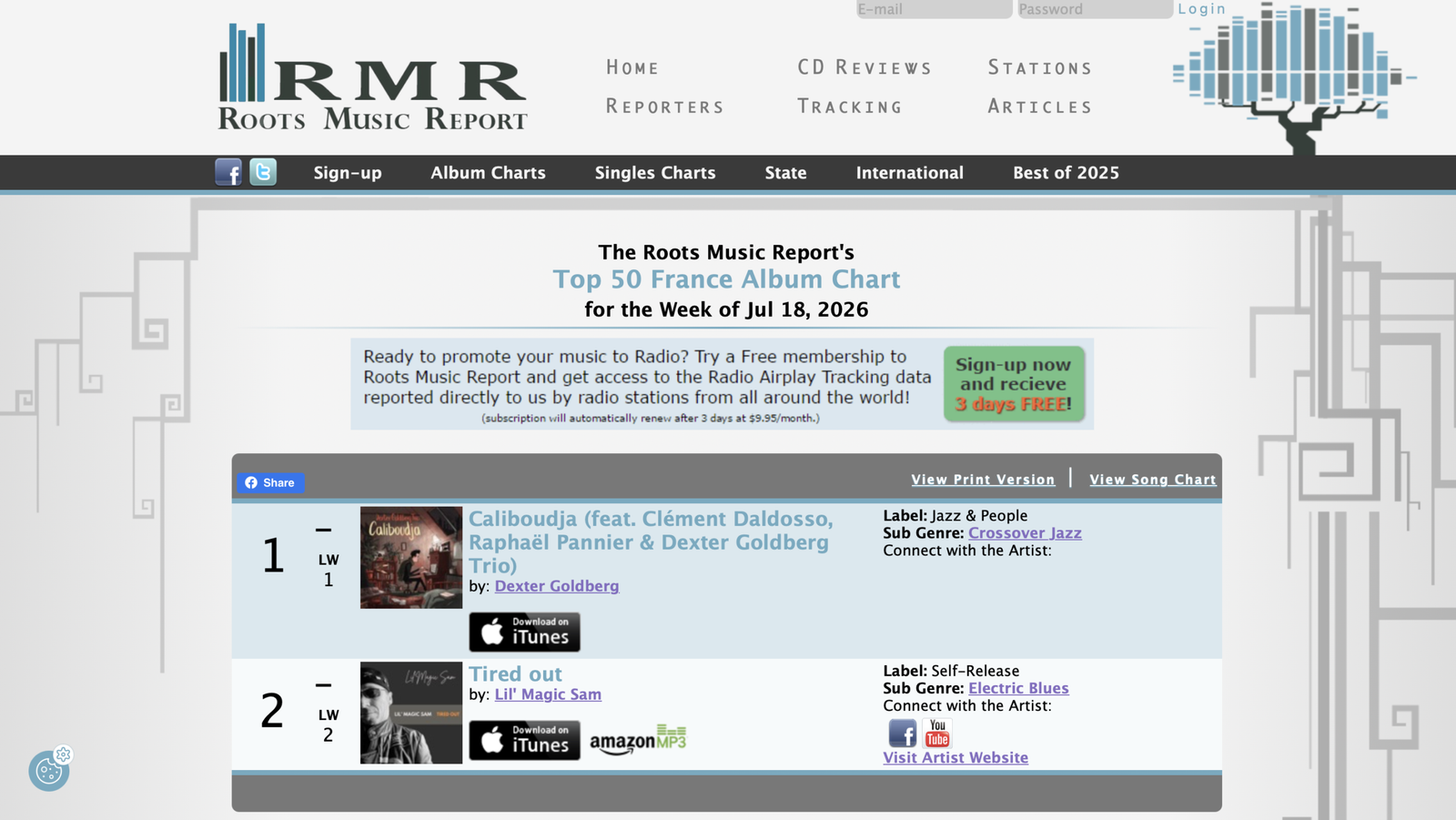
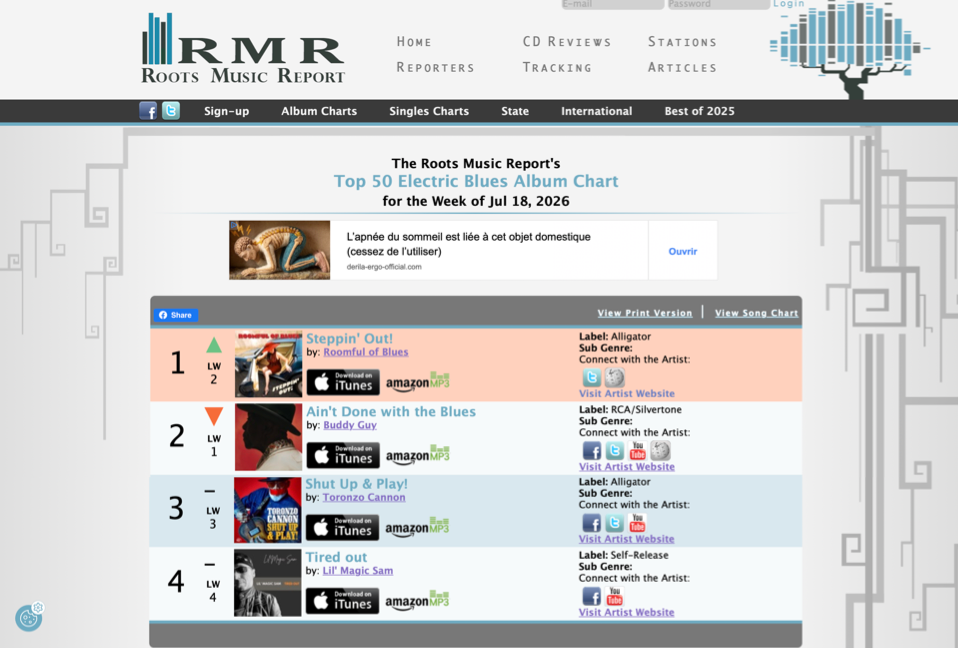
Album « TIRED OUT » Review 18.04.26 :
Tired Out is a high-energy electric blues record that leans heavily into classic Chicago-style influences while keeping a modern, self-produced edge.
It’s raw, fast-paced, and clearly made by someone who prioritizes feel and groove over polish. One reviewer describes it as packed with “enormous energy… often dizzying speed”, with no weak tracks across its 13-song runtime. The sound & style of the album rooted in electric blues, with touches of blues-rock, funk, and soul with prominent use of gritty guitar solos, expressive harmonica and Hammond organ keyboards. Vocals are rough-edged and expressive, sometimes slightly accented (Sam is French), which adds character rather than distraction The album moves quickly many tracks hit hard and don’t linger, giving it a live-band immediacy. Critics and listeners tend to point to tracks like:
– “Leaving Town” – explosive, fast opener
– – “Looking So Fine” – groove-heavy blues-rock
– – “Let Me Talk To You Mama” – classic call-and-response blues feel
– – “How Long Will It Last” – more melodic, almost summery tone
– “No More Time To Waste” – energetic closer
The title track “Tired Out” ironically feels anything but tired—driven by sharp guitar and tight rhythm.
Album’s Strengths – Consistent energy across all 13 tracks – Strong musicianship (especially guitar + harmonica interplay) – Authentic blues feel without sounding like a museum piece – No filler—rare for a 50+ minute indie blues album Tired Out is best described as a passionate, no-frills blues album made by a player who clearly loves the genre. It won’t reinvent blues, but it delivers exactly what fans want: tight grooves, fiery solos, and relentless momentum. If you like artists in the vein of classic Chicago blues or modern revivalists, this is a very satisfying, high-energy listen.

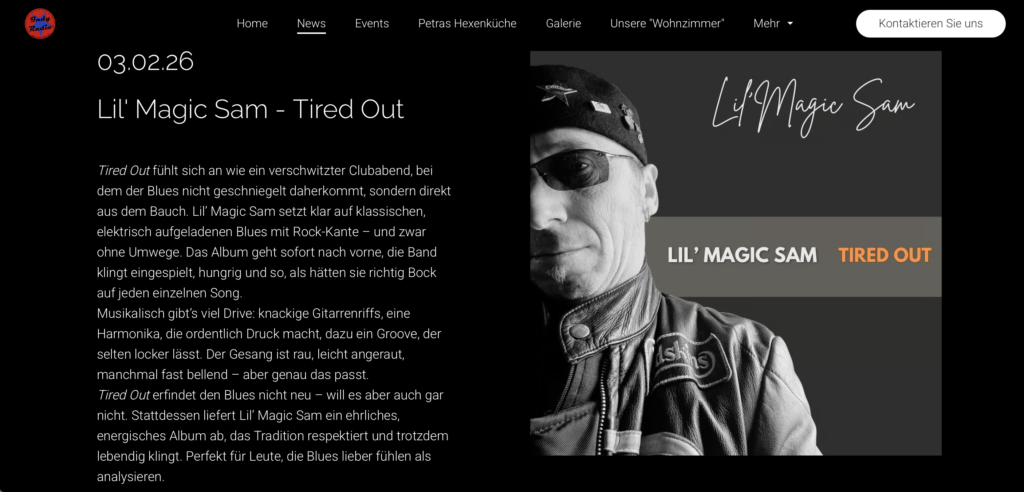
Traduction: Album »TIRED OUT » Review 03.02.2026
Tired Out évoque une nuit survoltée en club, où le blues, sans fioritures, jaillit des tripes. Lil’ Magic Sam se concentre clairement sur un blues classique et électrisant, teinté de rock, sans détour. L’album vous prend aux tripes dès les premières notes ; le groupe sonne soudé, affamé, et on sent qu’il est totalement investi dans chaque morceau.
Musically, there's plenty of drive: crisp guitar riffs, a harmonica that packs a punch, and a groove that rarely lets up. The vocals are raw, slightly raspy, sometimes almost barking – but that's exactly what works.
Tired Out doesn't reinvent the blues – and it doesn't try to. Instead, Lil' Magic Sam delivers an honest, energetic album that respects tradition yet still sounds vibrant. Perfect for people who prefer to feel the blues rather than analyze it.
Traduction: Album « TIRED OUT » Review 03.02.2026
Tired Out feels like a sweaty night at a club, where the blues isn't polished, but comes straight from the gut. Lil' Magic Sam clearly focuses on classic, electrically charged blues with a rock edge – and he does it without any detours. The album immediately hits you hard; the band sounds tight, hungry, and like they're really into every single song.
Musically, there's plenty of drive: crisp guitar riffs, a harmonica that packs a punch, and a groove that rarely lets up. The vocals are raw, slightly raspy, sometimes almost barking – but that's exactly what works.
Tired Out doesn't reinvent the blues – and it doesn't try to. Instead, Lil' Magic Sam delivers an honest, energetic album that respects tradition yet still sounds vibrant. Perfect for people who prefer to feel the blues rather than analyze it.



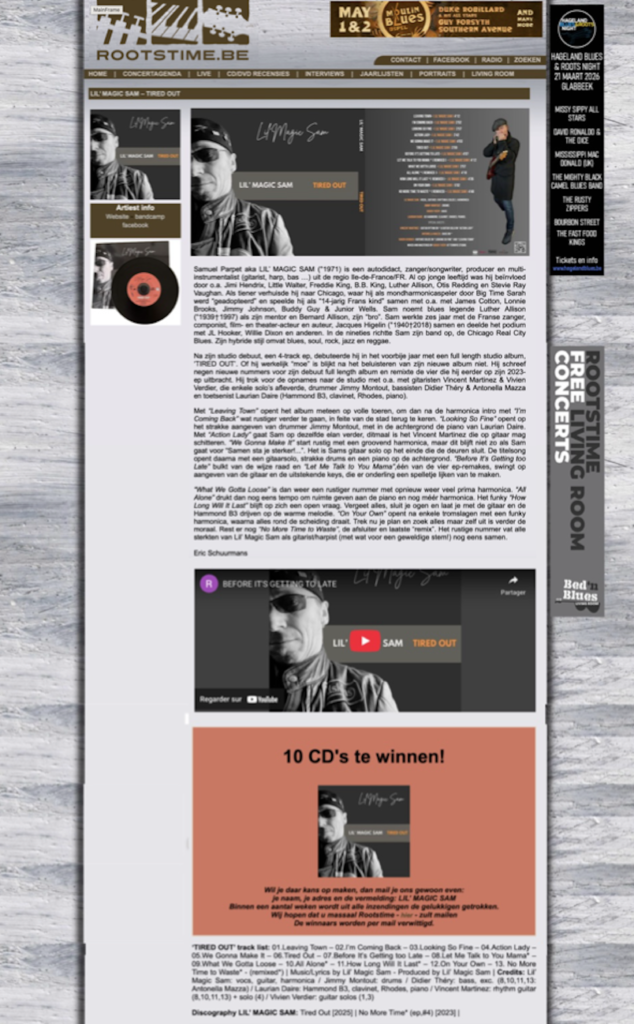
Lil’MAGIC SAM – “Tired Out” – Self-production If he has, so to speak, cut his teeth alongside the great Luther Allison, and also played and toured with the greatest, it is with a very personal first album that the singer, guitarist and harmonica player Lil’MAGIC SAM presents himself today. While his talents as a songwriter were already noticeable on the EP “No More Time” released in 2023, “Tired Out” shows an incredible variety between touching contemporary Blues and electrifying Blues Rock. And if his favorite instrument is very present, he carefully avoids
make the common thread. Balance happens naturally. In the music of Lil’MAGIC SAM vocals, the guitars respect the high ground, the organ is never very far away to give height and this deep and endearing finish hooks punchy pieces that are never demonstrative. Complete, accessible and melodic, “Tired Out” draws its energy from a roaring and intense register. With the harmonica which often doubles the voice, the musician offers original exchanges, deliciously groovy and full of nuances (“Leaving Town”, “Action Lady”, “We Gonna
Make It”, “All Alone”, “How Long Will It Last”).


Review: Lil’ Magic Sam –The album title, *Tired Out*, certainly does not seem to apply to Lil’ Magic Sam. Far from appearing weary, he drives the album with a healthy dose of energetic blues-rock and fiery guitar work. His deep, raspy voice is a perfect fit for the material, while his French accent lends the sound a unique and distinctive character. Although Lil’ Magic Sam is primarily a harmonica player, this album places a clear emphasis on the guitar. The harmonica serves mainly as accompaniment, while the keyboard parts are tastefully executed by Laurian Daire. Highlights include the funk track "Before It Gets Too Late," the magnificent slow blues "All Alone"—featuring a superb interplay between harmonica, piano, and guitar—and "How Long Will It Last," a track with a guitar sound strongly reminiscent of "The Healer" by John Lee Hooker and Carlos Santana.


Review: Lil’ Magic Sam –The album title, *Tired Out*, certainly does not seem to apply to Lil’ Magic Sam. Far from appearing weary, he drives the album with a healthy dose of energetic blues-rock and fiery guitar work. His deep, raspy voice is a perfect fit for the material, while his French accent lends the sound a unique and distinctive character. Although Lil’ Magic Sam is primarily a harmonica player, this album places a clear emphasis on the guitar. The harmonica serves mainly as accompaniment, while the keyboard parts are tastefully executed by Laurian Daire. Highlights include the funk track "Before It Gets Too Late," the magnificent slow blues "All Alone"—featuring a superb interplay between harmonica, piano, and guitar—and "How Long Will It Last," a track with a guitar sound strongly reminiscent of "The Healer" by John Lee Hooker and Carlos Santana. Tekst: Garard Haarhuis
Amis de la Zic-14 nov. 205
When you were born in 1971 (musical year of the century) and were trained in part by Luther Allison, aren't those 2 lucky stars?
Lil Magic Sam, no he is not the son of the great Bluesman Magic Sam, is French, self-taught multi-instrumentalist and songwriter.
For the business card:
Precocious, Sam found himself on stage at the age of 6, with Jacques Higelin... He appeared as a “Special Guest” alongside the biggest names in American Blues like BB KING (Montreux Jazz Festival in 1989), John Lee Hooker, Willie Dixon, Luther Allison, John Hammond jr, Buddy Guy, Junior Wells, James Cotton, Lonnie Brooks, Albert Collins, Charlie Musselwhite, Sunnyland Slim, Eddie Clearwater, Magic Slim and Lefty Dizz, Clarence Gatemouth Brown, Louisiana Red, Steve cropper, Little Milton, Billy Boy Arnold, Jimmy Johnson, Billy Branch, Clarence “Gatemouth” Brown, Melvin Taylor and many more… Excuse me! well ladies and gentlemen, this guy, who no one knows in France, has just released a magnificent album in 2025. If you want to take a tough Blues-style uppercut, this album is for you. He develops a powerful and hybrid style touching several styles.
It would now be a matter of turning it around, ladies and gentlemen, bookers!
Amis de la Zic-14 nov. 205
When you were born in 1971 (musical year of the century) and were trained in part by Luther Allison, aren't those 2 lucky stars?
Lil Magic Sam, no he is not the son of the great Bluesman Magic Sam, is French, self-taught multi-instrumentalist and songwriter.
For the business card:
Precocious, Sam found himself on stage at the age of 6, with Jacques Higelin... He appeared as a “Special Guest” alongside the biggest names in American Blues like BB KING (Montreux Jazz Festival in 1989), John Lee Hooker, Willie Dixon, Luther Allison, John Hammond jr, Buddy Guy, Junior Wells, James Cotton, Lonnie Brooks, Albert Collins, Charlie Musselwhite, Sunnyland Slim, Eddie Clearwater, Magic Slim and Lefty Dizz, Clarence Gatemouth Brown, Louisiana Red, Steve cropper, Little Milton, Billy Boy Arnold, Jimmy Johnson, Billy Branch, Clarence “Gatemouth” Brown, Melvin Taylor and many more… Excuse me! well ladies and gentlemen, this guy, who no one knows in France, has just released a magnificent album in 2025. If you want to take a tough Blues-style uppercut, this album is for you. He develops a powerful and hybrid style touching several styles.
It would now be a matter of turning it around, ladies and gentlemen, bookers!
Born in 1971, Lil' Magic Sam is a self-taught musician with an extraordinary career path. A producer, singer-songwriter, harmonica player, and guitarist, he first took to the stage at the age of six alongside Jacques Higelin. Quickly spotted by blues legends, he received his nickname, Little Magic Sam, from John Lee Hooker and Willie Dixon during a legendary night at the Casino de Paris. As a teenager, he left for Chicago, where he played with Big Time Sarah, James Cotton, Buddy Guy, Junior Wells... and became "the little Frenchy of the blues," praised by the American press. Back in France, he multiplied collaborations with Luther Allison, Bernard Allison, BB King, Didier Lockwood, Jesse Garon, and many others. LIL' MAGIC SAM TIRED OUT His style - the Chicago Heart & Soul Blues - blends urban grit with Afro-American heritage. After several breaks, including one devoted to fatherhood, Sam is now back with renewed energy and a deeply personal project, Tired Out, a solid full-length album following his 2023 EP No More Time - four tracks that heralded a powerful return to the forefront. It took time, silence, and a lot of life experience for Lil' Magic Sam to emerge with thirteen songs, each like a chapter from an intimate diary, carried by a voice perfectly suited to the task - gravelly, inhabited, as if it had weathered endless nights, dodgy soundchecks, and countless miles of asphalt. From Leaving Town onward, you can tell the blues here isn't a pose but a necessity. The guitar is gritty, the groove tight, and Sam sings as one breathes after surfacing from deep water. I'm Coming Back sounds like a kept promise — even prophetic — as the album overflows with restrained energy. Action Lady snaps like a riff of freedom, while Before It's Getting Too Late and No More Time to Waste ring out as lucid warnings, cries from the heart. Autobiographical through and through, Tired Out bears Sam's touch in every note. Hệ handles vocals, guitar, and harmonica, supported by a solid core: Didier Théry on bass, Jimmy Montout on drums, and Laurian Daire on keys. A few distinguished guests enrich the sound palette — Vincent Martinez on guitar, Antonella Mazza on bass, and Vivien Verdier, who delivers fiery solos on two tracks. The production is intentionally minimalist - round bass, dry drums - yet the arrangements are sharp and precise, never verbose. Every instrument finds its place; every silence matters. This is the real thing - raw, authentic blues that hits where it should. The record itself is a fine uppercut — an album with something to say. And it says it well. We wish him all the happiness he deserves, and above all, the joy of bringing these songs to life on stage. where his blues truly comes into its own. Zicazic Fred Delforge Mars 2026.
Born in 1971, Lil' Magic Sam is a self-taught musician with an extraordinary career path. A producer, singer-songwriter, harmonica player, and guitarist, he first took to the stage at the age of six alongside Jacques Higelin. Quickly spotted by blues legends, he received his nickname, Little Magic Sam, from John Lee Hooker and Willie Dixon during a legendary night at the Casino de Paris. As a teenager, he left for Chicago, where he played with Big Time Sarah, James Cotton, Buddy Guy, Junior Wells... and became "the little Frenchy of the blues," praised by the American press. Back in France, he multiplied collaborations with Luther Allison, Bernard Allison, BB King, Didier Lockwood, Jesse Garon, and many others. LIL' MAGIC SAM TIRED OUT His style - the Chicago Heart & Soul Blues - blends urban grit with Afro-American heritage. After several breaks, including one devoted to fatherhood, Sam is now back with renewed energy and a deeply personal project, Tired Out, a solid full-length album following his 2023 EP No More Time - four tracks that heralded a powerful return to the forefront. It took time, silence, and a lot of life experience for Lil' Magic Sam to emerge with thirteen songs, each like a chapter from an intimate diary, carried by a voice perfectly suited to the task - gravelly, inhabited, as if it had weathered endless nights, dodgy soundchecks, and countless miles of asphalt. From Leaving Town onward, you can tell the blues here isn't a pose but a necessity. The guitar is gritty, the groove tight, and Sam sings as one breathes after surfacing from deep water. I'm Coming Back sounds like a kept promise — even prophetic — as the album overflows with restrained energy. Action Lady snaps like a riff of freedom, while Before It's Getting Too Late and No More Time to Waste ring out as lucid warnings, cries from the heart. Autobiographical through and through, Tired Out bears Sam's touch in every note. Hệ handles vocals, guitar, and harmonica, supported by a solid core: Didier Théry on bass, Jimmy Montout on drums, and Laurian Daire on keys. A few distinguished guests enrich the sound palette — Vincent Martinez on guitar, Antonella Mazza on bass, and Vivien Verdier, who delivers fiery solos on two tracks. The production is intentionally minimalist - round bass, dry drums - yet the arrangements are sharp and precise, never verbose. Every instrument finds its place; every silence matters. This is the real thing - raw, authentic blues that hits where it should. The record itself is a fine uppercut — an album with something to say. And it says it well. We wish him all the happiness he deserves, and above all, the joy of bringing these songs to life on stage. where his blues truly comes into its own. Zicazic Fred Delforge Mars 2026.
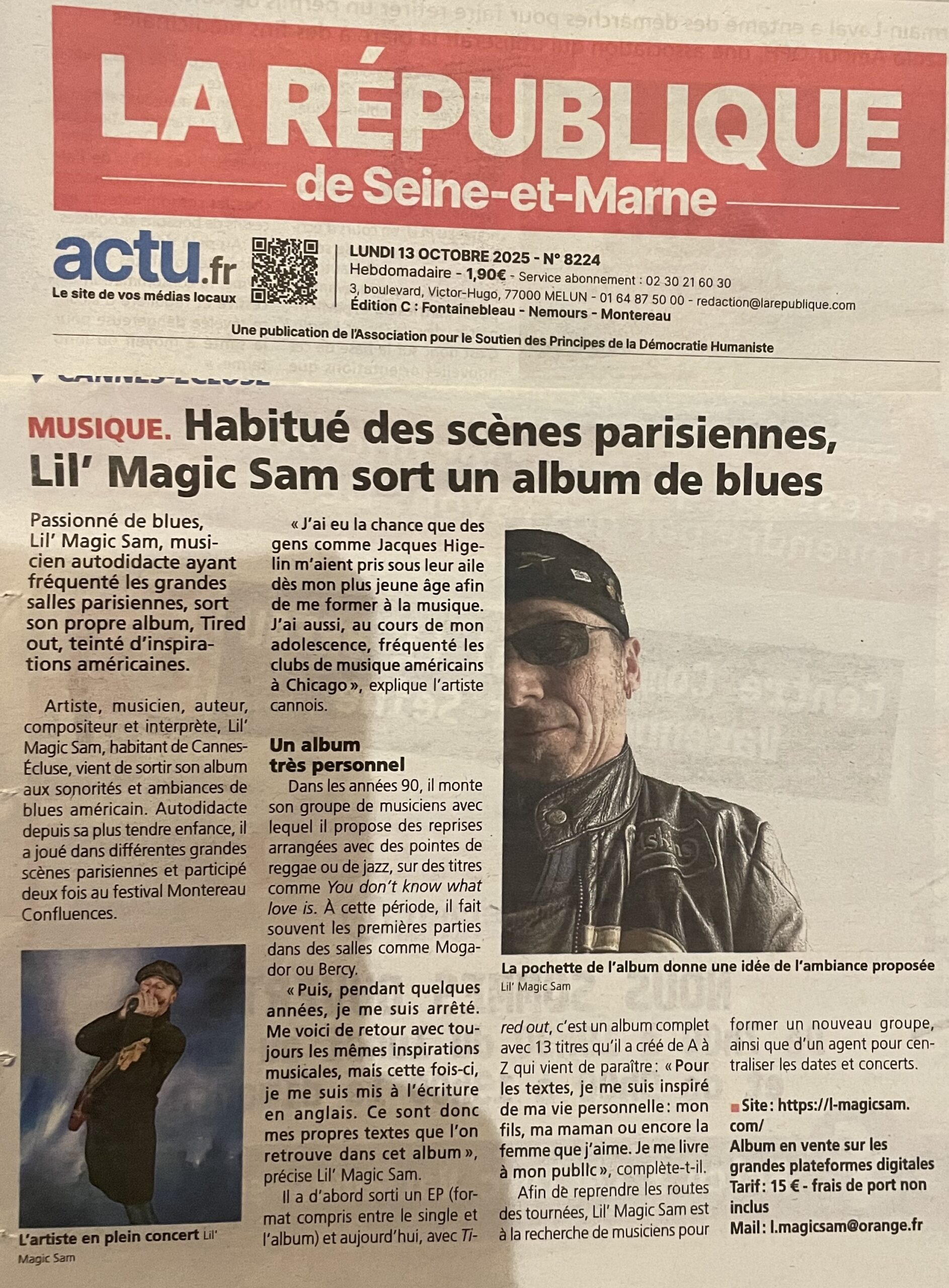


PODCAST » LA ROUTE DU BLUES » -RADIO STOLLIAC SENS DU JEUDI 16 OCTOBRE 2025.
Lill’MAGIC SAM with Edmond « Blues » Mathieu & Michel Perrier ( Proxy music )
PODCAST » LA ROUTE DU BLUES » RADIO STOLLIAC SENS DU JEUDI 16 OCTOBRE 2025.
Lill’MAGIC SAM with Edmond « Blues » Mathieu ( Stolliahc radio)
& Michel Perrier ( Proxy music ) at RADIO STOLLIAC

SAM was once a young harmonica prodigy, today he is a mature blues rocker. SAM was once a young harmonica prodigy, today he is a mature blues rocker.
Accompanied by Laurian Daire on keyboards, Vincent Martinez on second guitar, Antonella Mazza on bass and Jimmy Montout on drums, Sam is virile on vocals and electric guitar and only plays the harmonica on one of the four tracks of his square and sturdy Blues-rock.
Soul Bag n°252 P.64 – Blue Planet par Christophe Mourot. Article SOUL BAG -N° 252 –Oct-Nov-Dec 2023
SAM was once a young harmonica prodigy, today he is a mature blues rocker. SAM was once a young harmonica prodigy, today he is a mature blues rocker.
Accompanied by Laurian Daire on keyboards, Vincent Martinez on second guitar, Antonella Mazza on bass and Jimmy Montout on drums, Sam is virile on vocals and electric guitar and only plays the harmonica on one of the four tracks of his square and sturdy Blues-rock.
Soul Bag n°252 P.64 – Blue Planet par Christophe Mourot. Article SOUL BAG -N° 252 –Oct-Nov-Dec 2023
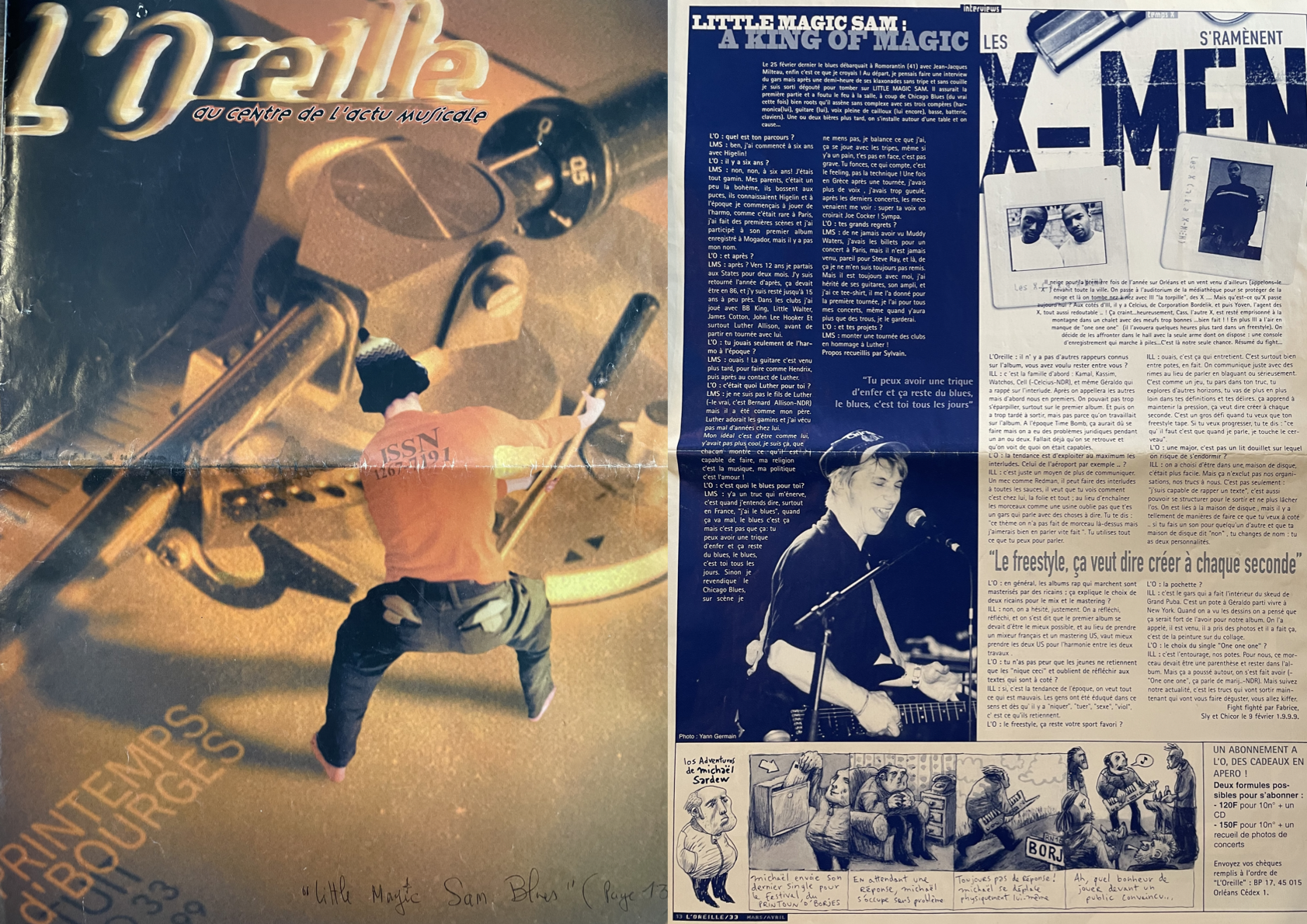
LITTLE MAGIC SAM : A KING OF MAGIC
« Tu peux avoir une trique d’enfer et ça reste du blues, le blues, c’est toi tous les Jours »
Le 25 février dernier le blues débarquait à Romorantin (41) avec Jean-Jacques Milteau, enfin c’est ce que je croyais! Au départ, je pensais faire une interview du gars mais après une demi-heure de ses klaxonades sans tripe et sans couille je suis sorti dégouté pour tomber sur LITTLE MAGIC SAM. Il assurait la première partie et a foutu le feu à la salle, à coup de Chicago Blues (du vrai cette fois) bien roots qu’il assène sans complexe avec ses trois compères (harmonica(lui), guitare (lai), voix pleine de cailloux (lui encore), basse, batterie. claviers). Une ou deux bières plus tard, on s’installe autour d’une table et on cause…
L’O: quel est ton parcours?
LMS: ben, jai commencé à six ans avec Higelin!
L’O: il y a six ans?
LMS : non, non, à six ans! J’étais tout gamin. Mes parents, C’était un peu la bohème, ils bossent aux puces, ils connaissaient Higelin et a l’époque je commençais à jouer de l’harmo, comme c’était rare à Paris. j’ai fait des premières scènes et j’ai participé à son album enregistré à Mogador mais il y a pas mon nom.
L’O: et après ?
LMS; après? Vers 12 ans je partais aux States pour deux mois. Jy suis retourné l’année d’après ça devait être en 86, et j’y suis resté jà chaque fois 2 mois à peu près. Je jouais dans les clubs . j’ai joué avec BB King, James Cotton, John Lee Hooker Et surtout Luther Allison, avant de partir en tournée avec lui.
L’O : tu jouais seulement de l’harmo à l’époque?
LMS : ouais ! La guitare C’est venu plus tard, pour faire comme Hendrix,
puis après au contact de Luther
L’O: c’était quoi Luther pour toi?
LMS : je ne suis pas le fils de Luther (-le vrai, c’est Bernard Allison-NDR) mais il a été comme mon père.
Luther adorait les gamins et j’ai vécu pas mal d’années chez lui.
Mon ideal c’est d’être comme lui, il n’ y avait pas plus cool, je suis ça, que
chacun montre ce qu’il est capable de faire, ma religion c’est la musique, ma politique c’est l’amour!
L’O : c’est quoi le blues pour toi?
LMS : y’a un truc qui m’énerve, c’est quand j’entends dire, surtout en France, j’ai le blues », quand ça va mal, le blues c’est ça mais c’est pas que ça: tu peux avoir une trique d’enfer et ça reste du blues, le blues. c’est toi tous les jours. Sinon je revendique le Chicago Blues, sur scène je ne mens pas, je balance ce que j’ai, ça se joue avec les tripes, même si y’a un pain, c’est pas grave, c’est pas grave. Tu fonces, ce qui compte, c’est le feeling, pas la technique ! Une fois en Grèce après une tournée, j’avais plus de voix . J’avais trop gueulé, après les derniers concerts, les mecs venaient me voir : super ta voix on croirait Joe Cocker ! Sympa.
L’O: tes grands regrets ?
LMS : de ne jamais avoir vu Muddy Waters, J’étais invité pour un concert à Paris, mais mes parents n’avaient pas le blé pour mettre de l’essence.On a pas pu y aller. Pareil pour Steve Ray, je l’ai raté . Et là, de ça je ne m’en suis toujours pas remis. Tout comme le décès de Luther.
Mais il est toujours avec moi, j’ai hérité d’une de ses guitares, son ampli, et j’ai ce tee-shirt, il me l’a donné pour la première tournée, je le mets pour tous mes concerts, même quand y’aura plus que des trous, je le garderai.
L’O: et tes projets?
LMS: monter une tournée des clubs en hommage à Luther !
Propos recueillis par Sylvain.


The back-to-school concert, Saturday evening at the jazz cellar, was a shock: “If this is back-to-school, I dream of it!” confirmed an amateur, while at midnight, the room in Nanteau-sur-Lunain was still full. It’s true that Little Magic Sam pulled out all the stops with the most authentic pieces, memories of stays in Chicago. Although not all the songs have the quality of “Who’s been talking?” or “Bad love” by Luther Allison, a theme that he began with his smoky voice in the silence of the Nantellian night. Because he has several types of voice, a guitar that captures his world and a harmonica that seduces. There were blues classics and discoveries with this well-surrounded little stage beast, during a program of more than 3 hours...Link
L’Eclaireur du Gâtinais, le 25 Août 2001
The back-to-school concert, Saturday evening at the jazz cellar, was a shock: “If this is back-to-school, I dream of it!” confirmed an amateur, while at midnight, the room in Nanteau-sur-Lunain was still full. It’s true that Little Magic Sam pulled out all the stops with the most authentic pieces, memories of stays in Chicago. Although not all the songs have the quality of “Who’s been talking?” or “Bad love” by Luther Allison, a theme that he began with his smoky voice in the silence of the Nantellian night. Because he has several types of voice, a guitar that captures his world and a harmonica that seduces. There were blues classics and discoveries with this well-surrounded little stage beast, during a program of more than 3 hours...Link
L’Eclaireur du Gâtinais, le 25 Août 2001


MAGIC
...The following evening was a real party for those who love rough, snotty and lively Blues: the little bomb that is Little Magic Sam hit very hard with his wonderfully readjusted covers ("Mojo Workin'" or "The Thrill Is Gone"). Sometimes, when he let go of his guitar and only (so to speak!) grab onto the microphone, he made one think of Eric Burdon having stolen the voice of Joe Cocker from Good Days. Moreover, this cheeky fellow from the seventeenth arrondissement (who nevertheless studied with Luther ALLISON) covers Lee Dorsey wonderfully: the ultimate proof of good taste...
Eric Tandy, Guitarist Magazine, Septembre 1997
MAGIC
...The following evening was a real party for those who love rough, snotty and lively Blues: the little bomb that is Little Magic Sam hit very hard with his wonderfully readjusted covers ("Mojo Workin'" or "The Thrill Is Gone"). Sometimes, when he let go of his guitar and only (so to speak!) grab onto the microphone, he made one think of Eric Burdon having stolen the voice of Joe Cocker from Good Days. Moreover, this cheeky fellow from the seventeenth arrondissement (who nevertheless studied with Luther ALLISON) covers Lee Dorsey wonderfully: the ultimate proof of good taste...
Eric Tandy, Guitarist Magazine, Septembre 1997
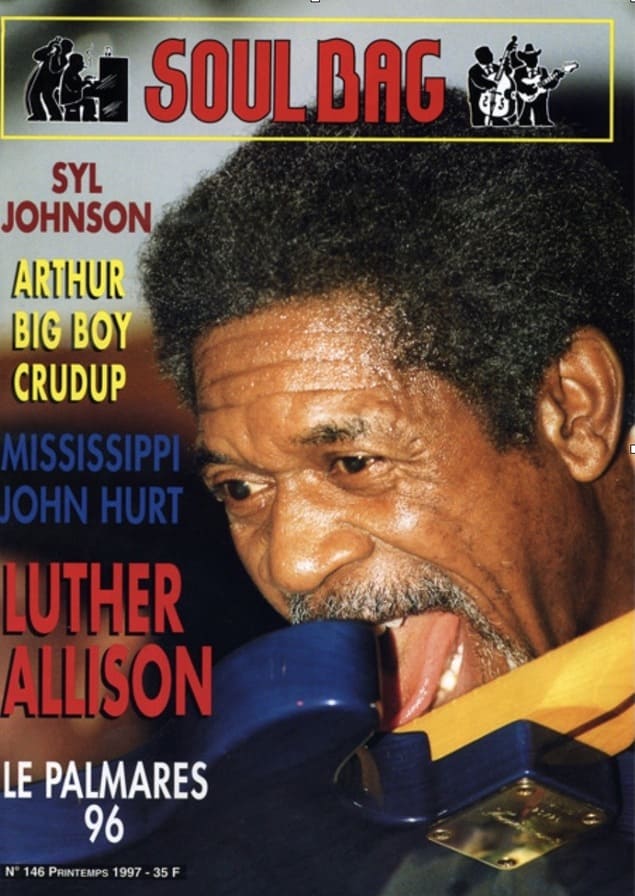

…Seeing Luther ALLISON is always a joy, he is there for his pleasure and intends to share it with the spectators. It's obvious... After the break, the festive and friendly side will become even more accentuated with the support of his friends. We will see Bernard in turn, and part of his group, Joanna Connor who had just performed at New Morning... But the one who impressed me the most is Little Magic Sam. Looking like a newsboy, with his cap askew and a smirk, he jumped on stage blowing his harmonica. Joanna Connor didn’t quite understand what was happening – dismay! – but Luther was delighted – satisfaction! – and gestured for him to follow him into the room. And they enjoyed jamming in the middle of the audience, soon swapping roles: Luther on harp and Sam on guitar.
Jacques Perrin, Soul Bag Mars 1997
…Seeing Luther ALLISON is always a joy, he is there for his pleasure and intends to share it with the spectators. It's obvious... After the break, the festive and friendly side will become even more accentuated with the support of his friends. We will see Bernard in turn, and part of his group, Joanna Connor who had just performed at New Morning... But the one who impressed me the most is Little Magic Sam. Looking like a newsboy, with his cap askew and a smirk, he jumped on stage blowing his harmonica. Joanna Connor didn’t quite understand what was happening – dismay! – but Luther was delighted – satisfaction! – and gestured for him to follow him into the room. And they enjoyed jamming in the middle of the audience, soon swapping roles: Luther on harp and Sam on guitar.
Jacques Perrin, Soul Bag Mars 1997

We often tend to consider what is in front of our door as part of the decor and of no real importance; that’s a bit what’s happening with the Blues and Chicago artists. The one who is the most popular Bluesman in Europe, Luther ALLISON, with a completely deserved reputation, thanks to his devastating stage performances, spent his adolescence in the Windy City and experienced his musical initiation there; the character is charismatic, and the musician exhilarating. The human warmth that exudes from his music is typical of an explosive mixture of Soul, Blues, and singing imbued with the fervor of Gospel. Luther's stage presence is legendary: on stage he is brilliant, sensual, full of humor, and provocative. Why then these constant back and forth movements between Chicago and Europe of Luther ALLISON, followed by an almost permanent installation in Paris? The number of Jazz and Blues artists who have had to seek recognition across the Atlantic, with an audience of selfless passion, would fill a long list. Luther is sentimentally attached to France which gave him his chance and celebrates it with enthusiasm because he is the first great Blues guitarist, after a few pianists, like Memphis Slim, to have emigrated to our country. Luther has long had a mixed group, African-American and… French! He even adopted a young prodigy harmonica player, Little Magic Sam, who made the heyday in the clubs of Chicago, the Mecca of the Blues, some time ago. The presence on the ground of this masterful guitarist has sparked many vocations among young groups in France. Luther saw clubs in Chicago's black neighborhoods close one after the other, and the Blues lose its popularity; he now sees him regaining ground and being honored in this gigantic festival. It was about time!
-Original Chicago Blues Annual by Jacques Lacava June 1990
We often tend to consider what is in front of our door as part of the decor and of no real importance; that’s a bit what’s happening with the Blues and Chicago artists. The one who is the most popular Bluesman in Europe, Luther ALLISON, with a completely deserved reputation, thanks to his devastating stage performances, spent his adolescence in the Windy City and experienced his musical initiation there; the character is charismatic, and the musician exhilarating. The human warmth that exudes from his music is typical of an explosive mixture of Soul, Blues, and singing imbued with the fervor of Gospel. Luther's stage presence is legendary: on stage he is brilliant, sensual, full of humor, and provocative. Why then these constant back and forth movements between Chicago and Europe of Luther ALLISON, followed by an almost permanent installation in Paris? The number of Jazz and Blues artists who have had to seek recognition across the Atlantic, with an audience of selfless passion, would fill a long list. Luther is sentimentally attached to France which gave him his chance and celebrates it with enthusiasm because he is the first great Blues guitarist, after a few pianists, like Memphis Slim, to have emigrated to our country. Luther has long had a mixed group, African-American and… French! He even adopted a young prodigy harmonica player, Little Magic Sam, who made the heyday in the clubs of Chicago, the Mecca of the Blues, some time ago. The presence on the ground of this masterful guitarist has sparked many vocations among young groups in France. Luther saw clubs in Chicago's black neighborhoods close one after the other, and the Blues lose its popularity; he now sees him regaining ground and being honored in this gigantic festival. It was about time!
-Original Chicago Blues Annual by Jacques Lacava June 1990


Luther Allison – Charlie Musselwhite
The Barrymore Theatre Madison, WI
Luther ALLISON’S power blues set caught fire instantly as his son, Bernard, displayed his blues bloodline. His high speed guitar work was more than reminiscent of his father and once Luther took the stage, the two exchanged a warm musical greeting as father tried to outplay son and vice versa. At some point in the show Bernard donnde a green electric guitar shaped like the continental U.S., a fitting symbol for our only true American musical form. Luther terms his music, «The New Blues». No doubt about it, his style is more upbeat than any blues artist I’ve ever seen. His «don’t hold anything back» style conjures up thoughts of Jeff Beck, Eric Clapton and Jimi Hendrix. He takes traditional blues, turns it inside out, and then increases the pace to a frenzied level. His lyrics aren’t about old men bemoaning the fact that their women have left them, instead his men have too many ladies chasing them. «You can’t exactly call it misery», laughs Luther. Luther seemed to take flight during the tune, «Life Is A Bitch». As he explains «Bitch» in that song means «Joy», the music and lyrics reflected his personal zest for living and his philosphy that life is to be enjoyed to it’s fullest. He played that way all night long. The Arkansas-born musician moved to Chicago with his family and that’s where he developed his blues style working with Magic Sam, Elmore James, Sunnyland Slim, Shakey Jake and Big Mama Thornton. A one time Madison resident, he appeared right at home on the Barrymore stage as he strode down the center aisle all the way into the lobby and back again, never once missing a beat as he continued to cook on his guitar the entire time. As a special treat, a couple of Luther’s friends joined him and his band during the last set. Little Magic Sam, a harmonica player from Paris, France (Luther’s homebase) and local saxaphonist Fat Richard Drake, who performed with Luther during his stint in Madison, added a nice touch to an evening of really rockin’blues.
Jeff Elsoffer Wisconsin States Journal
Thursday, June 14, 1990
Luther Allison- Charlie Musselwhite – The Barrymore Theatre Madison, WI
Luther ALLISON’S power blues set caught fire instantly as his son, Bernard, displayed his blues bloodline. His high speed guitar work was more than reminiscent of his father and once Luther took the stage, the two exchanged a warm musical greeting as father tried to outplay son and vice versa. At some point in the show Bernard donnde a green electric guitar shaped like the continental U.S., a fitting symbol for our only true American musical form. Luther terms his music, «The New Blues». No doubt about it, his style is more upbeat than any blues artist I’ve ever seen. His «don’t hold anything back» style conjures up thoughts of Jeff Beck, Eric Clapton and Jimi Hendrix. He takes traditional blues, turns it inside out, and then increases the pace to a frenzied level. His lyrics aren’t about old men bemoaning the fact that their women have left them, instead his men have too many ladies chasing them. «You can’t exactly call it misery», laughs Luther. Luther seemed to take flight during the tune, «Life Is A Bitch». As he explains «Bitch» in that song means «Joy», the music and lyrics reflected his personal zest for living and his philosphy that life is to be enjoyed to it’s fullest. He played that way all night long. The Arkansas-born musician moved to Chicago with his family and that’s where he developed his blues style working with Magic Sam, Elmore James, Sunnyland Slim, Shakey Jake and Big Mama Thornton. A one time Madison resident, he appeared right at home on the Barrymore stage as he strode down the center aisle all the way into the lobby and back again, never once missing a beat as he continued to cook on his guitar the entire time. As a special treat, a couple of Luther’s friends joined him and his band during the last set. Little Magic Sam, a harmonica player from Paris, France (Luther’s homebase) and local saxaphonist Fat Richard Drake, who performed with Luther during his stint in Madison, added a nice touch to an evening of really rockin’blues.
Jeff Elsoffer Wisconsin States Journal Thursday, June 14, 1990


Link-The Big Time Sarah Blues Show was swinging full force to the flow of «Sweet Home Chicago» inside Wise Fools Pub on Lincoln Avenue. It was late on a July weekend night and the band was already well into its second set. «And now,» said Sarah, breaking form her vocals, «I want y’all to give a big hand here for Sam.» Sarah clapped her hands and a slight, blond 14-year-old boy, not more than 5 feet tall and 90 pounds, emerged from the audience and joined the band on stage. He was carrying a harmonica and a microphone. Within a minute he was into the song, accompanying the band’s quickning beat, his blues harmonica deep and soulful. The audience listened curiously at first, many disbelieving. His soud was clear and full, seemingly too qtudied and rich to be the wurk of so young a musician. Members of the band smilled knowingly. By the end of the set, judging by the loud applause, the disbelieving had been converted. «Who is this kid ?» someone asked. No one seemed to know. after the set , several audience members approached the young man to shake his hand and compliment him. He appeared embarrassed, and without saying a word he retreated from the room. what no one realized was that Sam, whose full name is Samuel PARPET , doesn’t speak a word of English. But agter listening to him, they knew he has a special talent, an exceptional ability to play the blues, to evoke the adult emotions and feelings that are at the heart of his music. A few nights later, before anther performance with the Big Time Sarah Blues Show, this one a few blocks avay at B.L.U.E.S. on Halsted, PARPET took the time to explain, with his friend Isabelle Ramerie acting as interpreter, his backgrouind and how he learned to play such passionate blues. He described how as a young boy growing up in the small town of Chartres, France, located about 60 miles outside of Paris, he would spend hours listening to his parents’ extensive collection of blues albums. The albums were mostly Chicago-style recordings by such blues luminaries as Jimmy JOHNSON , Billy Boy ARNOLD , Albert KING , B.B. KING and Sugar BLUE . His parents, both devout blues enthusiasts- who make dolls and sell them at the free market in Paris- gave him a harmonica when he was 2 so he could play along with the music. They would also take him into Paris to listen to blues concerts. As he grew older, his parents noticed something unusual about him. It seemed he could really play good blues- hand-clapping, hooting, fast-shuffling blues, the kind they play in Chicago. It wasn’t long before his parents’ friends, some of them musicians, heard Sam blowing his harmonica and acting as if he knew what he was doing. And the next thing Sam knew, he was up on stage playing serious, old-time blues. The same musicians he was listening to on record albums in Chartres, and watching from the audience in the Paris concert halls, were now inviting him to get up on stage with them and jam. By the time he was 13, he had performed with his idol, French blues and rock musician Jacques HIGELIN , and the popular Luther ALLISON , a favorite of European blues fans. He also had playde with a few Chicagoans, Willie DIXON and Sugar BLUE among them, who reinforced his desire to travel to America. So this summer, with the help of Ramerie, a family friend who works at B.L.U.E.S., Sam came to Chicago. Since his arrival, he «He doesn’t want to do anything has been making the rounds of local blues clubs. He doesn’t want to do anything else,» Ramerie says. Sarah Streeter, he «BIG TIME» it the Big Time Sarah Blues Show, remenbers her first encounter with PARPET , when she was sufficiently impressed to hire him to play with her. unusual at his age. He likes the faster «I think he definitely has a Chicago style of playing, which is very pace. He likes to show that he can play anything, but be doesn’t have a big head about him. He doesn’t try to overpower the band or show off.». If you missed PARPET’S last scheduled appearance, you might want to drop in on any of the blues clubs in the city to see if he’s playing. Tuesday night, for instance, he will be at Wise Fools Pub for their open jam session from 9 P.M. to 2 A.M. He’ playing on staying in Chicago until August 29.
By David Prescott Chicago Tribune, 21 July 1986.
Link-The Big Time Sarah Blues Show was swinging full force to the flow of «Sweet Home Chicago» inside Wise Fools Pub on Lincoln Avenue. It was late on a July weekend night and the band was already well into its second set. «And now,» said Sarah, breaking form her vocals, «I want y’all to give a big hand here for Sam.» Sarah clapped her hands and a slight, blond 14-year-old boy, not more than 5 feet tall and 90 pounds, emerged from the audience and joined the band on stage. He was carrying a harmonica and a microphone. Within a minute he was into the song, accompanying the band’s quickning beat, his blues harmonica deep and soulful. The audience listened curiously at first, many disbelieving. His soud was clear and full, seemingly too qtudied and rich to be the wurk of so young a musician. Members of the band smilled knowingly. By the end of the set, judging by the loud applause, the disbelieving had been converted. «Who is this kid ?» someone asked. No one seemed to know. after the set , several audience members approached the young man to shake his hand and compliment him. He appeared embarrassed, and without saying a word he retreated from the room. what no one realized was that Sam, whose full name is Samuel PARPET , doesn’t speak a word of English. But agter listening to him, they knew he has a special talent, an exceptional ability to play the blues, to evoke the adult emotions and feelings that are at the heart of his music. A few nights later, before anther performance with the Big Time Sarah Blues Show, this one a few blocks avay at B.L.U.E.S. on Halsted, PARPET took the time to explain, with his friend Isabelle Ramerie acting as interpreter, his backgrouind and how he learned to play such passionate blues. He described how as a young boy growing up in the small town of Chartres, France, located about 60 miles outside of Paris, he would spend hours listening to his parents’ extensive collection of blues albums. The albums were mostly Chicago-style recordings by such blues luminaries as Jimmy JOHNSON , Billy Boy ARNOLD , Albert KING , B.B. KING and Sugar BLUE . His parents, both devout blues enthusiasts- who make dolls and sell them at the free market in Paris- gave him a harmonica when he was 2 so he could play along with the music. They would also take him into Paris to listen to blues concerts. As he grew older, his parents noticed something unusual about him. It seemed he could really play good blues- hand-clapping, hooting, fast-shuffling blues, the kind they play in Chicago. It wasn’t long before his parents’ friends, some of them musicians, heard Sam blowing his harmonica and acting as if he knew what he was doing. And the next thing Sam knew, he was up on stage playing serious, old-time blues. The same musicians he was listening to on record albums in Chartres, and watching from the audience in the Paris concert halls, were now inviting him to get up on stage with them and jam. By the time he was 13, he had performed with his idol, French blues and rock musician Jacques HIGELIN , and the popular Luther ALLISON , a favorite of European blues fans. He also had playde with a few Chicagoans, Willie DIXON and Sugar BLUE among them, who reinforced his desire to travel to America. So this summer, with the help of Ramerie, a family friend who works at B.L.U.E.S., Sam came to Chicago. Since his arrival, he «He doesn’t want to do anything has been making the rounds of local blues clubs. He doesn’t want to do anything else,» Ramerie says. Sarah Streeter, he «BIG TIME» it the Big Time Sarah Blues Show, remenbers her first encounter with PARPET , when she was sufficiently impressed to hire him to play with her. unusual at his age. He likes the faster «I think he definitely has a Chicago style of playing, which is very pace. He likes to show that he can play anything, but be doesn’t have a big head about him. He doesn’t try to overpower the band or show off.». If you missed PARPET’S last scheduled appearance, you might want to drop in on any of the blues clubs in the city to see if he’s playing. Tuesday night, for instance, he will be at Wise Fools Pub for their open jam session from 9 P.M. to 2 A.M. He’ playing on staying in Chicago until August 29.
By David Prescott Chicago Tribune, 21 July 1986.


Après le Minnesota et l’Iowa, Louis Baumard nous écrit de l’Illinois. A Chicago, ville qui a donné son nom à une célèbre forme de blues, il a rencontré un petit français qui souffle déjà comme un pro dans son harmonica. CHICAGO (Illinois). – L’endroit, sur Lincoln Avenue, s’appelle «BLUES», tout simplement, comme la musique que l’on y joue. La meilleure de Chicago, affirme Garry Bogolub. La foule qui se presse dans la salle sombre et longilignecompte plus de Blancs que de Noirs. Ils appartiennent à la classe moyenne et ne dépassent pas les 35 ans. Malgré la jeunesse du public, Larry n’envisage pas l’avenir du blues avec optimisme. «Le blues meurt. Luther ALLISON a émigré à Paris parce qu’ici il ne pouvait plus vivre de sa musique. Les jeunes Noirs préfèrent le rap, le reggae, le funk où comme à Washington, le gogo. Le blues n’est pas un genre musical qui fait vendre beaucoup de disques et on ne l’entend pas beaucoup à la radio. Pourquoi les Blancs s’y intéressent-ils plus que les Noirs ? «Ça, il faut le demander aux sociologues». La salle du «BLUES» a continué de se remplir et Lonnie BROOKS est monté sur scène avec deux autres guitaristes et un batteur. Il est l’un des grands de la spécialité. Sa musique est plus que mâtinée de rock et le public vibre. Et puis, tout à coup, un gamin blond se joint à eux. Il ressemble à Oscar, le héros du «Tambour». Mais de sa mallette d’écolier il tire un harmonica. Et joue. Joie et surprise dans la salle. Il a la maîtrise d’un professionnel, sinon le souffle. Pendant un moment, Lonnie BROOKS le laissera jouer en solo. Nouvelle surprise pour le public lorsqu’il apprend que le jeune prodige vient de «Peuriss». Un français ! Samuel PARPET, Sam de ce côté-ci de l’Atlantique, n’est pas tout à fait parisien. Il habite à Mainvilliers, près de Chartres. Grand amateur de la musique de Muddy WATERS – son musicien préféré, précise t-il – il partage une passion familiale. Ses parents connaissent Luther ALLISON. Ensemble ils ont pensé que la meilleure façon d’améliorer le jeu de Sam serait de le faire venir à Chicago. Les vacances de l’élève PARPET seront donc bien remplies entre les cours d’anglais – il reconnaît qu’il en a bien besoin – et les soirées blues, avec des intermèdes prometteurs comme cette émission qui lui est proposée par des producteurs de télévisions Noirs. S’il existe à Chicago un dernier carré d’amateurs. Larry souligne que le Blues s’est profondément ancré en Europe. Sam PARPET est là pour le montrer. Et comme il a l’intention de continuer sur cette voie.. Louis Baumard Ouest France 08/1986
After Minnesota and Iowa, Louis Baumard writes to us from Illinois. In Chicago, the city which gave its name to a famous form of blues, he met a little Frenchman who already blows his harmonica like a pro. CHICAGO, Illinois. – The place, on Lincoln Avenue, is simply called “BLUES”, like the music they play there. The best in Chicago, says Garry Bogolub. The crowd crowding the dark, slender room included more white people than black people. They belong to the middle class and do not exceed the age of 35. Despite the youth of the audience, Larry does not view the future of the blues with optimism. “The blues are dying. Luther ALLISON emigrated to Paris because he could no longer make a living from his music here. Young blacks prefer rap, reggae, funk or, as in Washington, gogo. The blues is not a musical genre that sells a lot of records and you don't hear it much on the radio. Why are white people more interested in it than black people? “That, you have to ask sociologists.” The “BLUES” room continued to fill and Lonnie BROOKS took the stage with two other guitarists and a drummer. He is one of the greats in the field. His music is more than mixed with rock and the audience vibrates. And then, suddenly, a blond kid joins them. He looks like Oscar, the hero of “Drum”. But from his school bag he takes a harmonica. And play. Joy and surprise in the room. He has the control of a professional, if not the breath. For a while, Lonnie BROOKS let him play solo. New surprise for the public when they learn that the young prodigy comes from “Peuriss”. A Frenchman! Samuel PARPET, Sam on this side of the Atlantic, is not entirely Parisian. He lives in Mainvilliers, near Chartres. A big fan of the music of Muddy WATERS – his favorite musician, he specifies – he shares a family passion. His parents knew Luther ALLISON. Together they figured the best way to improve Sam's game would be to bring him to Chicago. The PARPET student's holidays will therefore be busy between English lessons – he admits that he really needs them – and blues evenings, with promising interludes like this show which is offered to him by Black television producers. If there is a last square of amateurs in Chicago. Larry emphasizes that the Blues has become deeply rooted in Europe. Sam PARPET is here to show it. And as he intends to continue on this path…..
Louis Baumard Ouest France 08/1986

CELEBRITY SCOOPS !!!!
FRENCH HARP PLAYER…. Little Magic Sam will be appearing this Sunday August 23 for two shows at 5:00 PM and 6:30 PM. You never know who might stop in to « Jam » on a given night. Of course every Tuesday night Wise Fools features an open blues jam hosted by Glen Davis and Straightshooter, however, some of the best jams are spontaneous. Carlos SANTANA dropped in after his concert at Poplar Creek to jam with Sugar BLUE, Buddy GUY and Lee OSKAR, the harmonica player from « War ». They played until well after our usual closing time. We have also had the pleasure of welcoming Samuel PARPET to the Wise Fools stage. PARPET is a 15 year old harmonica player visiting Chicago from France. It is likely to find him at the Fools for the Tuesday night jam or on August I with Sugar BLUE. Chicago Bears player Tim Wrightman has been frequenting the pub lately. A major film production compagny also spent the day at Wise Fools working on top secret project. Whose next ??? By Deneen Kaly, Wise Fools Pub Newsletter, August 1987
CELEBRITY SCOOPS !!!!
FRENCH HARP PLAYER…. Little Magic Sam will be appearing this Sunday August 23 for two shows at 5:00 PM and 6:30 PM. You never know who might stop in to “Jam” on a given night. Of course every Tuesday night Wise Fools features an open blues jam hosted by Glen Davis and Straightshooter, however, some of the best jams are spontaneous. Carlos SANTANA dropped in after his concert at Poplar Creek to jam with Sugar BLUE, Buddy GUY and Lee OSKAR, the harmonica player from “War”. They played until well after our usual closing time. We have also had the pleasure of welcoming Samuel PARPET to the Wise Fools stage. PARPET is a 15 year old harmonica player visiting Chicago from France. It is likely to find him at the Fools for the Tuesday night jam or on August I with Sugar BLUE. Chicago Bears player Tim Wrightman has been frequenting the pub lately. A major film production compagny also spent the day at Wise Fools working on top secret project. Whose next ??? By Deneen Kaly, Wise Fools Pub Newsletter, August 1987
À qui le prochain ??? Par Deneen Kaly, Wise Fools Pub Newsletter, août 1987

Journée de l’harmonica Salle Wagram
A big special nod for little Little Magic Sam who knew how to make us appreciate his incredible diatonic playing, at the age of 11 (the value doesn't wait).”
Harmonicas magazine 12/1985
Journée de l’harmonica Salle Wagram
A big special nod for little Little Magic Sam who knew how to make us appreciate his incredible diatonic playing, at the age of 11 (the value doesn't wait).”
Harmonicas magazine 12/1985

Jazz in Malval – Barely arriving on the stage of Granges de Malval, Luther ALLISON takes the audience at a frantic pace into the vibrant world of his blues-rock. His style is electric, like that of many Chicago musicians. It is strongly influenced by BB KING's style of playing and singing, but the sober and finesse playing of Albert KING is certainly also grafted onto his vigorous improvisations. A “Stormy Monday” was there to remind us! Chicago was also the city of Muddy WATERS. And it is a surprising tribute that Luther ALLISON paid to this great bluesman: “a 12-year-old blond kid, Little Magic Sam, Parisian disguised as David Crockett, made himself an attentive and very skilled partner on the harmonica. And this to the greatest joy of the public.”-Philippe Schneider Tribune de Genève 08/1984
Jazz in Malval – Barely arriving on the stage of Granges de Malval, Luther ALLISON takes the audience at a frantic pace into the vibrant world of his blues-rock. His style is electric, like that of many Chicago musicians. It is strongly influenced by BB KING's style of playing and singing, but the sober and finesse playing of Albert KING is certainly also grafted onto his vigorous improvisations. A “Stormy Monday” was there to remind us! Chicago was also the city of Muddy WATERS. And it is a surprising tribute that Luther ALLISON paid to this great bluesman: “a 12-year-old blond kid, Little Magic Sam, Parisian disguised as David Crockett, made himself an attentive and very skilled partner on the harmonica. And this to the greatest joy of the public.”-Philippe Schneider Tribune de Genève 08/1984
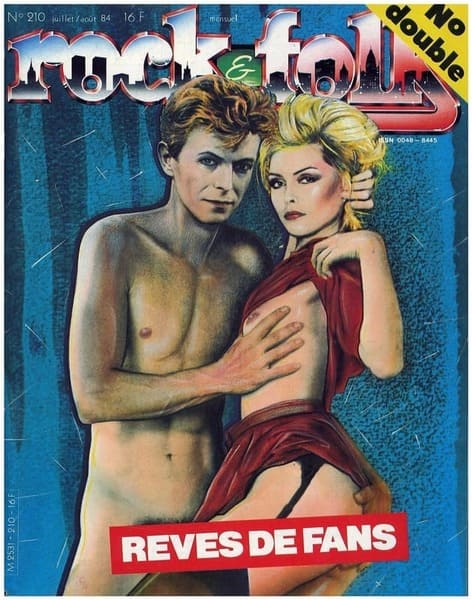
BOBINO –«Luther ALLISON et Jacques HIGELIN se marraient bien sur la scène du Bobino quand un petit blondinet de 12 ans environs s’est mis à faire swinguer son harmonica avec une précision, une drôlerie et une assurance digne d’un fils de «South Side». Ce diable de gamin, le petit sammy leur a volé la vedette, en fermant les yeux on aurait pu croire que c’était Little WALTER…».Rock & Folk 07/1984
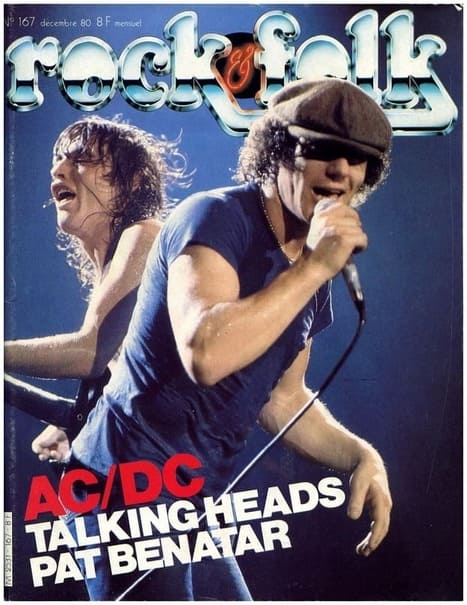
MOGADOR – Finir l’année avec HIGELIN à Mogador c’était une idée, un dernier concert, et hop là. «Jacques HIGELIN invita à faire le boeuf un petit gamin blond de 9 ans environ, et qui devait être son fils (je suppose) a joué de l’harmonica en mesure avec la compagnie».H.R. Rock & Folk 12/1980
Bobino – “Luther ALLISON and Jacques HIGELIN were having a good time on the Bobino stage when a little blond boy around 12 years old started swinging his harmonica with a precision, humor and confidence worthy of a son of “South Side”. This devilish kid, little sammy stole the show, if you closed your eyes you would have thought it was Little WALTER..."
Rock & Folk 07/1984
Mogador – Ending the year with HIGELIN in Mogador was an idea, one last concert, and that’s it. “Jacques HIGELIN invited a little blond kid of about 9 years old to jam, and who must have been his son (I suppose) played the harmonica in time with the company.”
H.R. Rock & Folk 12/1980